Pew’s 2035 projection: Islam could become the world’s largest religious group
1 views
Genel
Islamic Center of Washington, August 24, 2008. Archive photograph, not a Pew research event or a representation of today’s population. Photo: AgnosticPreachersKid / Wikimedia Commons, CC BY-SA 3.0. Original file unchanged; display scales to the screen. Source and license: [9][10].
Pew Research Center’s November 18 report projects 3.6 billion Muslims worldwide by 2070. Europe’s Muslim population could rise from 46 million to 80 million, while the US share could increase from 1.2% to 3.7%. The baseline is 2020; future figures are conditional demographic projections.
What the new report says: largest group does not mean a majority
Pew Research Center’s November 18, 2026 study projects that Muslims could outnumber Christians by 2035 if recent trends continue. Both groups are growing, but Muslim growth is faster. The projected Muslim share in 2070 is about 36% of humanity. Being the largest religious group would therefore not mean constituting a majority of the world’s population. [1]
From 2020 to 2070: roughly 2 billion to 3.6 billion
The Muslim-population chapter projects 80% growth between 2020 and 2070, compared with 11% among non-Muslims. These are not results of a 2026 census. The model also projects that Pakistan will overtake Indonesia by 2070, with 461 million Muslims. Sub-Saharan Africa’s Muslim population is projected to grow from 369 million to about 980 million, shifting the geographic balance. [2]
Europe: 46 million to 80 million, with different national trajectories
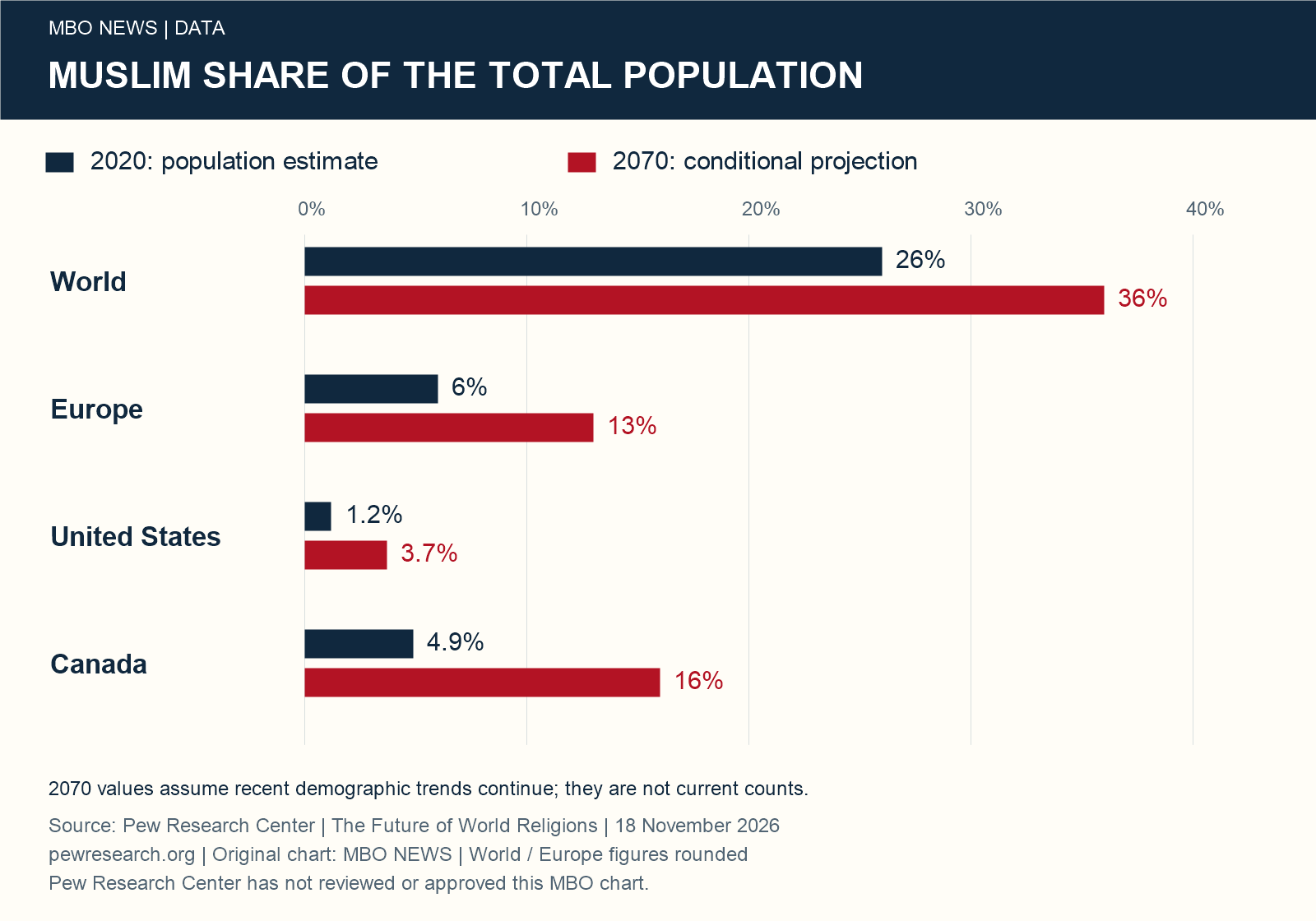
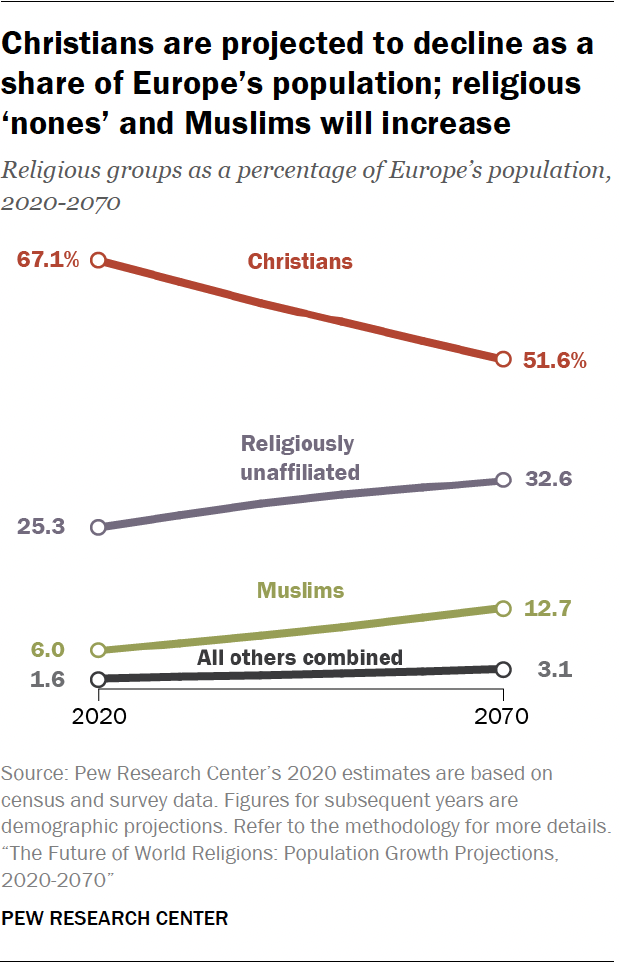
Muslims accounted for about 6% of Europe’s population in 2020; the projected share in 2070 is roughly 13%, or an increase from about 46 million to 80 million. France’s share is projected to rise from 9% to 20%, and Germany’s from 7% to 14%. Christians would still constitute about 52% of Europe’s population in 2070. The report therefore does not project a Muslim majority in Europe. [3]
The United States and Canada are separate cases
Pew’s North America region here comprises the United States and Canada. Its Muslim population is projected to increase from roughly 6 million to 20 million; that regional total should not be presented as a US figure. Muslims represented 1.2% of US residents in 2020, with 3.7% projected for 2070. Canada’s figures are 4.9% and approximately 16%, respectively. [4]
MBO data chart: one scale, different regions
Original chart: MBO NEWS. Data: Pew Research Center, November 18, 2026. Navy bars show 2020 estimates; red bars show conditional projections for 2070. World and Europe figures are rounded. [1][3][4]
This chart compares shares of total population, not headcounts. A region’s percentage change and its contribution to the global Muslim population are different questions. All bars use the same percentage scale starting at zero; smaller shares are not enlarged on separate axes.
Pew’s original Europe chart
Original English-language chart reproduced unchanged. Source: “The Future of Religion in Europe,” Pew Research Center, Washington, D.C., November 18, 2026. Report and terms are linked in the sources. [3][11]
Pew’s detailed chart shows Europe’s Muslim share rising from 6.0% to 12.7%; the 13% figure in the report’s prose is rounded. The original also shows Christians and people with no religious affiliation, providing the wider context. [3]
Drivers: age structure, births and migration
Pew identifies demographic dynamics as the principal global drivers: a younger Muslim population and births exceeding deaths. For 2020–2025, estimated total fertility is 3.1 children per Muslim woman and 2.5 per Christian woman. This is a demographic indicator calculated from the period’s birth rates, not an observed lifetime count. The projection also assumes fertility differences gradually narrow. [5]
Religious switching and population growth are different processes
Migration is important to projected Muslim growth in North America. Religious switching is modeled as a net reduction, rather than an addition, to the region’s Muslim population. Many people leaving Christianity become religiously unaffiliated instead of joining another faith. A decline in the Christian share therefore cannot be treated as an equivalent flow into Islam. [4][5]
A separate historical period: what changed in 2010–2020?
Pew’s earlier study, published in June 2025, examined the historical period from 2010 to 2020. It estimated Muslim growth of 347 million people, or 21%, to roughly 2 billion. The new report was published on November 18, 2026 and projects forward to 2070. The publication dates and periods covered by the two studies are different. [7]
Neither a guaranteed future nor a count of today’s population
Covering 201 countries and territories, the model incorporates age, fertility, mortality, migration and religious switching. Wars, epidemics, disasters or major policy changes could alter outcomes. Geography also matters: the study assigns Turkey to Asia-Pacific and Russia to Europe. Its Europe figures should not be read as European Union totals. [6]
How to read the numbers
Percentages and headcounts measure different things; the total population can also change while a group’s share rises. The 2020 column is a baseline estimate, while 2070 is a conditional projection. The country table and methodology are linked below. These demographic categories do not by themselves establish individuals’ political views or the intensity of their religious practice. [6][8]
Source and graphic note
This source-based report was prepared by MBO NEWS. The MBO chart is an original visualization of Pew data; Pew’s original Europe chart is reproduced unchanged. This does not imply Pew endorses MBO NEWS or any religious or political viewpoint. [11]
At his White House news conference, Trump threatened high taxes on American companies building data centers abroad. Seeking to keep investment in the United States, he also said he and China had agreed on AI safeguards. The remarks do not themselves constitute an enacted new tax.
Read story →NSA headquarters, Fort Meade, undated archive photograph · Archive photo, not this event · National Security Agency · Source / rightsNSA · November 20, 2026 · 12:38 ET
US officials described the outages as separate technical incidents. Phased recovery is reported at NSA; full restoration remains unconfirmed.
Read story →Archive: Donald Trump speaks before boarding Air Force One in Florida on November 8, 2026. Not a photograph of Manila or the Shenzhen summit. Official White House Photo / Patrick Witty.White House · November 20, 2026 · 10:29 ET
Press-pool reports confirm Trump returned to the White House on November 19 evening. A news conference is scheduled for noon EST on November 20; this dossier examines public outcomes, media interpretations and implementation questions.
State Department, Harry S. Truman Building, 2024 · Archive photo, not this event · U.S. Department of State / Linda D. Epstein · Source / rightsState Department · November 19, 2026 · 12:36 ET
Homeland Security Secretary Markwayne Mullin discussed the FAA communications outage with reporters outside the White House on November 13.
Read story →Pentagon, May 11, 2021 · Archive photo, not this event · Air Force Staff Sgt. Brittany A. Chase, DOD · Source / rightsPentagon · November 19, 2026 · 12:36 ET
The November 13 national ground stop ended. FAA’s subsequent statement describes investigation of network instability and no indication of an external attack; the November 14 cancellation snapshot below is retained as historical reporting.
Read story →White House, aerial view · Archive photo, not this event · Carol M. Highsmith · Source / rightsWhite House · November 17, 2026 · 11:09 ET
FEMA and the FCC plan a nationwide emergency alert test for Tuesday, November 17, at about 2:20 p.m. Eastern. TV and radio programming is expected to pause for roughly one minute. Cellphones are not included, and the public does not need to take action.
Read story →Pentagon and the Potomac River · Archive photo, not this event · "DoD photo by Master Sgt. Ken Hammond, U.S. Air Force." · Source / rightsPentagon · November 17, 2026 · 09:56 ET
CENTCOM said on November 17 that Iranian drones directed toward Bahrain were intercepted without injury to American personnel or damage to US equipment. It rejected the Revolutionary Guards’ claim that a US radar had been hit, according to Iran International’s report that day.
Read story →US Capitol, west front, 1997 · Archive photo, not this event · Architect of the Capitol · Source / rightsCongress · November 17, 2026 · 05:48 ET
Senate Commerce ranking Democrat Maria Cantwell criticised Commerce Secretary Howard Lutnick over access to advanced AI chips by China-linked companies.
Read story →Pentagon, May 11, 2021 · Archive photo, not this event · Air Force Staff Sgt. Brittany A. Chase, DOD · Source / rightsPentagon · November 14, 2026 · 00:38 ET
According to the Pentagon, Medal of Honor recipient Dakota Meyer visited several military bases during his first three weeks leading the Barracks Task Force to assess service members’ housing problems. The announcement emphasizes the goal of clean, comfortable accommodation; it does not establish that improvements at all facilities have been completed.
Read story →Pentagon and the Potomac River · Archive photo, not this event · "DoD photo by Master Sgt. Ken Hammond, U.S. Air Force." · Source / rightsPentagon · November 14, 2026 · 00:38 ET
The Naval Academy and Marine Corps dedicated a retired AV-8B Harrier II as a permanent display at Navy-Marine Corps Memorial Stadium in Annapolis, Maryland, according to the Pentagon. The installation honors more than a century of academy graduates who served as Marine aviators.
Read story →Robert F. Kennedy Department of Justice Building, Washington, D.C. · Archive photo, not this event · Voice of America · Source / rightsDOJ · November 14, 2026 · 00:38 ET
Johnson Controls and two subsidiaries agreed to pay $5 million to resolve allegations of failing to meet cybersecurity requirements in federal contracts and subcontracts, the Justice Department said. The contracts covered building products and services, including HVAC work. This is a settlement of allegations, rather than a report of a criminal conviction.
Read story →Robert F. Kennedy Department of Justice Building, Washington, D.C. · Archive photo, not this event · Voice of America · Source / rightsDOJ · November 14, 2026 · 00:38 ET
Antonio Oseguera Cervantes, 67, of Michoacán, Mexico, was sentenced to 270 months in prison for international drug trafficking and firearm offenses, the Justice Department announced. The sentence equals 22 years and six months. The department presented the case as part of its Homeland Security Task Force initiative.
Read story →J. Edgar Hoover Building, Washington, D.C. · Archive photo, not this event · FBI · Source / rightsFBI · November 14, 2026 · 00:38 ET
An international investigation targeting dark-web drug trafficking led to 354 arrests in 14 countries, according to the FBI. The agency reported seizures of more than 5.7 metric tons of illicit drugs and over $234 million in cryptocurrency and cash. Arrests do not establish that every suspect has been convicted.
Read story →White House, aerial view · Archive photo, not this event · Carol M. Highsmith · Source / rightsWhite House · November 14, 2026 · 00:38 ET
The White House announced on November 12 that it sent nominations for Nathan Anonick and Matthew Rowland to serve on the Commodity Futures Trading Commission, and for Kristin N. Johnson and Steven Levine to serve on the Securities and Exchange Commission. Submission to the Senate does not mean confirmation is complete or that nominees have taken office.
Read story →US Capitol, west front, 1997 · Archive photo, not this event · Architect of the Capitol · Source / rightsCongress · November 14, 2026 · 00:38 ET
H.R. 11031, introduced in the House on November 12, would codify a tipline for suspected fraud involving commercial driver’s licenses issued to people unlawfully present in the United States. If enacted, it would require the Homeland Security secretary, in coordination with Transportation, to operate the line within 180 days, publish accessible reporting methods and provide annual reports. The bill was referred to the Transportation and Infrastructure Committee and is not enacted law.
Read story →State Department building, alternate view, 2024 · Archive photo, not this event · U.S. Department of State / Linda D. Epstein · Source / rightsState Department · November 14, 2026 · 00:38 ET
The State Department submitted a customer-experience information collection request to the Office of Management and Budget. Its November 10 Federal Register notice provides a 30-day public comment period. This is an administrative consultation notice, rather than a new foreign policy decision.
Read story →Pentagon, May 11, 2021 · Archive photo, not this event · Air Force Staff Sgt. Brittany A. Chase, DOD · Source / rightsPentagon · November 12, 2026 · 16:59 ET
A sentinel at the Tomb of the Unknown Soldier was commended for ensuring a group maintained respect following a Veterans Day ceremony. This information was reported by the official source.
Read story →Robert F. Kennedy Department of Justice Building, Washington, D.C. · Archive photo, not this event · Voice of America · Source / rightsDOJ · November 12, 2026 · 16:46 ET
The Department of Justice announced coordinated actions against the Democratic People’s Republic of Korea (DPRK) government's schemes to fund its regime through massive cryptocurrency theft.
Read story →Robert F. Kennedy Department of Justice Building, Washington, D.C. · Archive photo, not this event · Voice of America · Source / rightsDOJ · November 12, 2026 · 16:16 ET
Thomas Osbeck, aged 70, from Ft. Myers, Florida, has been indicted by a federal grand jury in the Southern District of Florida on charges of engaging in and attempting to engage in illicit sexual conduct with minors in Haiti.
Read story →Pentagon and the Potomac River · Archive photo, not this event · "DoD photo by Master Sgt. Ken Hammond, U.S. Air Force." · Source / rightsPentagon · November 12, 2026 · 16:14 ET
Thousands of U.S. and multinational forces are participating in Joint Pacific Multinational Readiness Center Rotation 27-01 across the Hawaiian Islands. This participation is part of joint preparations for a long-range air assault.
Read story →Pentagon, May 11, 2021 · Archive photo, not this event · Air Force Staff Sgt. Brittany A. Chase, DOD · Source / rightsPentagon · November 12, 2026 · 16:14 ET
A sentinel at the Tomb of the Unknown Soldier was commended for ordering a group to maintain respect following a Veterans Day ceremony. This information was provided by the official Department of Defense.
Read story →Robert F. Kennedy Department of Justice Building, Washington, D.C. · Archive photo, not this event · Voice of America · Source / rightsDOJ · November 12, 2026 · 15:31 ET
The U.S. Department of Justice's Joint Criminal Opioid and Darknet Enforcement (JCODE) team, in partnership with Europol, conducted Operation TorNado: a coordinated, multi-agency international law enforcement effort targeting criminal networks trafficking fentanyl, opioids, and other illicit drugs via Dark Web markets. The operation resulted in over 350 arrests worldwide and the seizure of drugs, weapons, and assets exceeding $234 million.
Read story →White House, aerial view · Archive photo, not this event · Carol M. Highsmith · Source / rightsWhite House · November 12, 2026 · 15:18 ET
AP, citing police, reports that five people were shot in Washington DC’s Logan Circle on November 12: one was killed and four injured. The incident occurred about one mile north of the White House.
Read story →White House, aerial view · Archive photo, not this event · Carol M. Highsmith · Source / rightsWhite House · November 11, 2026 · 17:23 ET
On Veterans Day, President Donald J. Trump stood at Arlington National Cemetery and rendered the nation's highest salute to those who continue to bear the cost of freedom. The Commander-in-Chief honored every patriot who has worn the uniform in a speech echoing across the quiet hills of fallen heroes.
Read story →Book cover: Little, Brown and Company / Hachette Book GroupWhite House · November 11, 2026 · 10:13 ET
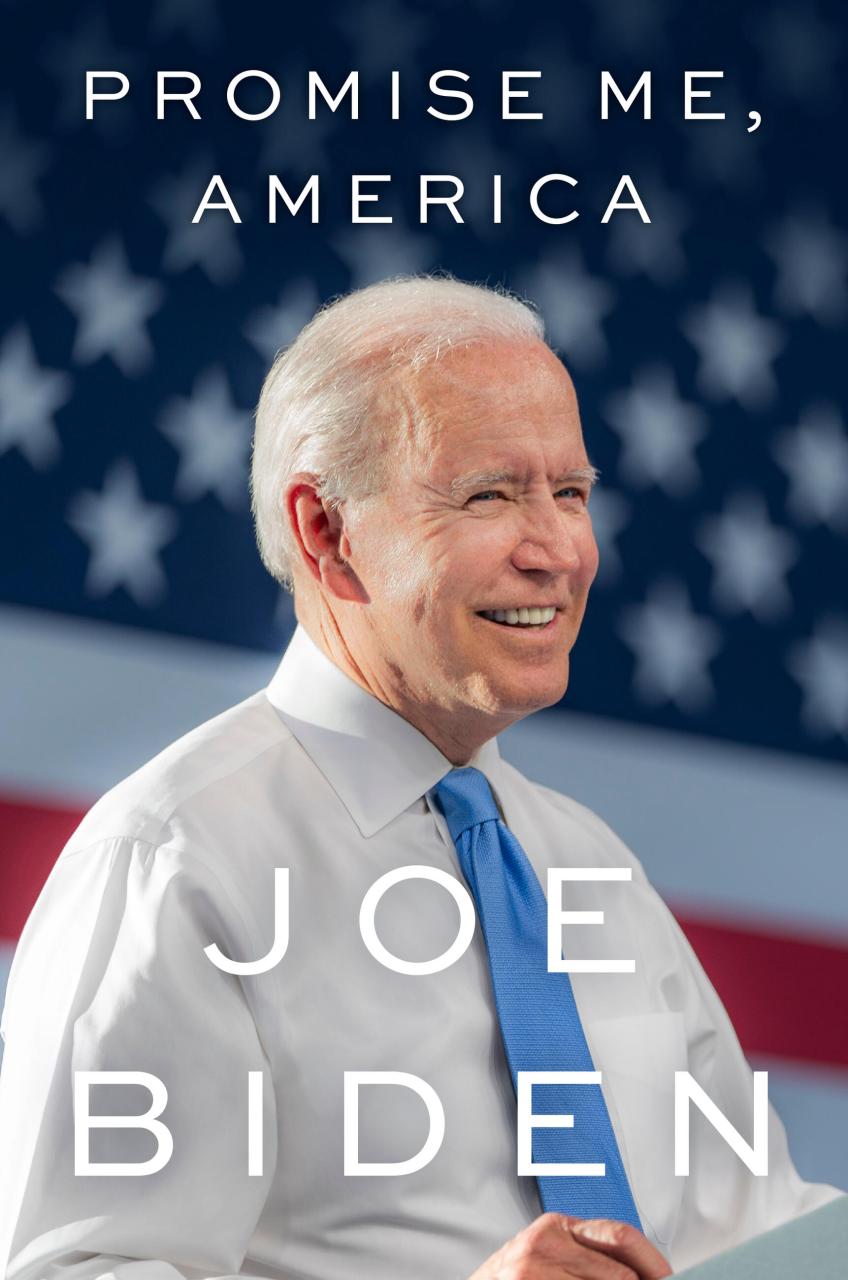
Joe Biden’s Promise Me, America, due November 17, brings Trump’s 2021 letter into focus. What the publisher lists, what reported excerpts reveal and how the White House responded.
Read story →Robert F. Kennedy Department of Justice Building, Washington, D.C. · Archive photo, not this event · Voice of America · Source / rightsDOJ · November 11, 2026 · 09:39 ET
Alexander Scott Mercurio, 21, from Coeur d’Alene, Idaho, was sentenced by U.S. District Judge David C. Nye to 18 years in prison and lifetime supervised release. Mercurio was charged with attempting to provide material support and resources to ISIS, a designated foreign terrorist organization.
Read story →Robert F. Kennedy Department of Justice Building, Washington, D.C. · Archive photo, not this event · Voice of America · Source / rightsDOJ · November 11, 2026 · 09:39 ET
The Justice Department said a New Jersey man pleaded guilty to filing false tax returns for clients. The statement put the intended loss to the United States at $327,647.
Read story →Robert F. Kennedy Department of Justice Building, Washington, D.C. · Archive photo, not this event · Voice of America · Source / rightsDOJ · November 11, 2026 · 09:39 ET
Abdulhafiz Bahovatdiny, a 36-year-old dual citizen of Kazakhstan and Tajikistan, was extradited from Egypt to the United States. He made his initial court appearance in Phoenix, Arizona to face charges related to his alleged role in a human smuggling conspiracy, according to officials.
Read story →Robert F. Kennedy Department of Justice Building, Washington, D.C. · Archive photo, not this event · Voice of America · Source / rightsDOJ · November 11, 2026 · 09:39 ET
The Justice Department has issued two fact sheets aimed at helping servicemembers and their dependents avoid unnecessary rent payments and costly fees. The first fact sheet explains how servicemembers and dependents can terminate residential or business leases upon receiving eligible military orders. The second fact sheet explains how certain vehicle leases can be ended by servicemembers and their dependents.
Read story →J. Edgar Hoover Building, Washington, D.C. · Archive photo, not this event · FBI · Source / rightsFBI · November 11, 2026 · 09:39 ET
Federal firearms licensees (FFLs) in the United States can now search an FBI-managed database when firearms are sold to them. This service allows them to find out within seconds if a firearm might be stolen.
Read story →Robert F. Kennedy Department of Justice Building, Washington, D.C. · Archive photo, not this event · Voice of America · Source / rightsDOJ · November 11, 2026 · 09:36 ET
The U.S. District Court for the Northern District of Georgia issued a permanent injunction against tax return preparer Tanja D. Hollis of Griffin, Georgia, and her business, Tanja Tax Preparations, LLC. The injunction prohibits Hollis from acting as a tax return preparer, preparing tax returns, or assisting others in tax return preparation. It also bars her from engaging in conduct that interferes with the proper administration and enforcement of internal revenue laws and from promoting any false tax schemes.
Read story →White House, aerial view · Archive photo, not this event · Carol M. Highsmith · Source / rightsWhite House · November 10, 2026 · 16:26 ET
In a proclamation by the President of the United States, it is stated that for over 250 years, the liberties and freedoms of every American have been safeguarded by heroic men and women who have faithfully served in the United States Armed Forces. On Veterans Day 2026, the nation’s cherished veterans are honored and there is a renewed commitment to strengthening this.
Read story →White House, aerial view · Archive photo, not this event · Carol M. Highsmith · Source / rightsWhite House · November 10, 2026 · 16:25 ET
The President of the United States, under constitutional and federal authority, issued a determination concerning wildfire suppression activities. This determination was communicated through a memorandum addressed to the Secretary of the Interior, the Secretary of Agriculture, and the Administrator of the Environmental Protection Agency. Further details are outlined in the official statement.
Read story →Robert F. Kennedy Department of Justice Building, Washington, D.C. · Archive photo, not this event · Voice of America · Source / rightsDOJ · November 10, 2026 · 14:57 ET
A man from Queens pleaded guilty to defrauding Medicare and New York State Medicaid of approximately $127 million by billing for medically unnecessary prescription drugs and social adult day care services that were not provided. These allegations are reported by the Department of Justice.
Read story →Pentagon and the Potomac River · Archive photo, not this event · "DoD photo by Master Sgt. Ken Hammond, U.S. Air Force." · Source / rightsPentagon · November 10, 2026 · 14:55 ET
The aircraft carrier USS Nimitz completed its first east coast training underway to support carrier qualifications for both new and experienced naval aviators.
Read story →Robert F. Kennedy Department of Justice Building, Washington, D.C. · Archive photo, not this event · Voice of America · Source / rightsDOJ · November 10, 2026 · 14:42 ET
An eight-count indictment unsealed by the U.S. Department of Justice charges Mohammad Baqer Saad Dawood al-Saadi, a dual Iranian-Iraqi national; Mohsen Mohajeri, Iranian national; and Mohammad Ali al-Hassani, Iraqi national with terrorism-related offenses. The charges relate to their support for Kata’ib Hizballah and Iran’s Islamic Revolutionary Guard Corps, designated as foreign terrorist organizations by the U.S., including involvement in nearly 20 attacks and attempts across Europe and the U.S., and a September 2026 terror plot targeting a British Royal Air Force Base in Fairford where U.S. forces were stationed.
Read story →Pentagon, May 11, 2021 · Archive photo, not this event · Air Force Staff Sgt. Brittany A. Chase, DOD · Source / rightsPentagon · November 10, 2026 · 14:25 ET
Secretary of War Pete Hegseth hosted Poland's Deputy Prime Minister and Defense Minister Władysław Kosiniak-Kamysz at the Pentagon during a bilateral engagement. They announced their intent to boost military cooperation.
Read story →Robert F. Kennedy Department of Justice Building, Washington, D.C. · Archive photo, not this event · Voice of America · Source / rightsDOJ · November 10, 2026 · 14:12 ET
The Justice Department announced that 36 individuals have been charged in a multi-state Homeland Security Task Force investigation involving drug trafficking and money laundering. Among those charged, nine are illegal aliens. The investigation spans international borders and the information was released by the Department of Justice.
Read story →White House, aerial view · Archive photo, not this event · Carol M. Highsmith · Source / rightsWhite House · November 10, 2026 · 14:10 ET
Secretary of War Pete Hegseth systematically dismissed the baseless impeachment attempt initiated by a disgruntled and defeated Congressman. Hegseth clarified that every operation targeted in the eight articles was lawful, ordered by the Commander-in-Chief, properly notified to Congress, and carried out by warriors who delivered decisive results.
Read story →Robert F. Kennedy Department of Justice Building, Washington, D.C. · Archive photo, not this event · Voice of America · Source / rightsDOJ · November 10, 2026 · 13:57 ET
A woman in Illinois was sentenced to 36 months in prison for running a multi-million-dollar COVID-19 pandemic assistance and unemployment benefits fraud scheme. She was also ordered to serve two years of supervised release and to pay $11,130,490 in restitution plus a forfeiture money judgment of $1,965,712. These details were announced by the Department of Justice.
Read story →Pentagon and the Potomac River · Archive photo, not this event · "DoD photo by Master Sgt. Ken Hammond, U.S. Air Force." · Source / rightsPentagon · November 10, 2026 · 12:25 ET
Secretary of War Pete Hegseth, facing the threat of impeachment, detailed a record of successful operations during his tenure at a Pentagon press briefing.
Read story →Robert F. Kennedy Department of Justice Building, Washington, D.C. · Archive photo, not this event · Voice of America · Source / rightsDOJ · November 10, 2026 · 11:42 ET
The U.S. District Court for the District of Arizona denied a preliminary injunction motion to stop construction of the Hermosa Critical Minerals Project. This project aims to create a domestic source of manganese and significantly increase zinc production, both essential for steel in military vehicles and naval ships. Manganese is also critical in battery-grade form for advanced lithium-ion batteries used in unmanned aerial vehicles, radios, and other defense equipment. The U.S. is almost entirely reliant on imports for manganese and zinc, with China supplying about 95% of global refining capacity for manganese used in advanced batteries.
Read story →Robert F. Kennedy Department of Justice Building, Washington, D.C. · Archive photo, not this event · Voice of America · Source / rightsDOJ · November 9, 2026 · 20:50 ET
The Justice Department filed a lawsuit against Lyft Inc. for discriminating against passengers with disabilities, including those who use service animals and mobility devices like stowable wheelchairs. Lyft provides an important transportation option for millions across the U.S. The lawsuit seeks $53 million for disabled individuals who have submitted complaints to Lyft or the Department alleging discrimination.
Read story →Robert F. Kennedy Department of Justice Building, Washington, D.C. · Archive photo, not this event · Voice of America · Source / rightsDOJ · November 9, 2026 · 19:53 ET
Saiful Islam, 39, a Bangladeshi national, pleaded guilty today to charges related to his role in a conspiracy that smuggled numerous aliens through South America, Central America, and Mexico to the United States.
Read story →Robert F. Kennedy Department of Justice Building, Washington, D.C. · Archive photo, not this event · Voice of America · Source / rightsDOJ · November 9, 2026 · 19:52 ET
The Justice Department awarded Jackson, Mississippi more than $63 million through its Model Cities Initiative (MCI). The initiative aims to reduce violent crime, restore law and order, and strengthen public safety. The department describes MCI as a flagship effort to enhance community safety across the country.
Read story →Robert F. Kennedy Department of Justice Building, Washington, D.C. · Archive photo, not this event · Voice of America · Source / rightsDOJ · November 9, 2026 · 19:51 ET
The United States Department of Justice sued the City of Glendale, California, alleging that it violated citizens' fundamental rights under the Second Amendment by requiring unreasonable fees to obtain concealed carry permits.
Read story →Robert F. Kennedy Department of Justice Building, Washington, D.C. · Archive photo, not this event · Voice of America · Source / rightsDOJ · November 9, 2026 · 19:49 ET
The Justice Department awarded St. Louis, Missouri more than $68 million through its Model Cities Initiative (MCI). This initiative aims to reduce violent crime, restore law and order, and strengthen public safety.
Read story →White House, aerial view · Archive photo, not this event · Carol M. Highsmith · Source / rightsWhite House · November 9, 2026 · 17:59 ET
The White House announced that Philip Lawrence Aubart has been nominated to serve as United States District Judge for the Middle District of North Carolina, succeeding the retiring William Lindsay Osteen, Jr. Additionally, Natalie Baker, a Career Member of the Senior Foreign Service from Texas, has been nominated to be Ambassador Extraordinary and Plenipotentiary of the United States. These nominations were sent to the Senate according to the White House.
Read story →Pentagon, May 11, 2021 · Archive photo, not this event · Air Force Staff Sgt. Brittany A. Chase, DOD · Source / rightsPentagon · November 9, 2026 · 15:58 ET
U.S. Navy Rear Adm. Greg Huffman met with South Korean navy leaders and delivered remarks aboard the ROKS Hansando during the ship's first port call at Naval Air Station Pensacola, Florida. Huffman emphasized the role of allied partnerships in naval education and training.
Read story →Pentagon and the Potomac River · Archive photo, not this event · "DoD photo by Master Sgt. Ken Hammond, U.S. Air Force." · Source / rightsPentagon · November 9, 2026 · 14:58 ET
Secretary of War Pete Hegseth stated in a speech at the U.S. Naval War College that the fundamental duty of America's armed forces is to ensure victory in war. He said the nation's senior service colleges must have a curriculum that supports this duty.
Read story →White House, aerial view · Archive photo, not this event · Carol M. Highsmith · Source / rightsWhite House · November 8, 2026 · 19:26 ET
Attorney General Todd Blanche stated on Sunday shows that the Department of Justice will fulfill its Constitutional duty to represent the Executive Branch. Blanche said that Democrats' explicit threats of endless investigations, impeachments, and retribution against President Trump, Cabinet officials, and private citizens will not succeed. These statements were issued by the White House.
Read story →White House, aerial view · Archive photo, not this event · Carol M. Highsmith · Source / rightsWhite House · November 8, 2026 · 19:20 ET
The October jobs report exceeded expectations, confirming that President Trump's America First agenda is driving a manufacturing renaissance. According to the White House, tariffs and tax cuts are reshoring production, strengthening supply chains, raising blue-collar wages, and creating hundreds of thousands of jobs for American workers.
Read story →Pentagon, May 11, 2021 · Archive photo, not this event · Air Force Staff Sgt. Brittany A. Chase, DOD · Source / rightsPentagon · November 8, 2026 · 19:02 ET
The commander of U.S. Central Command (CENTCOM) directed the establishment of a task force aimed at preventing Iran from using ground routes to transport advanced weapons and other materials. This task force is intended to support ongoing U.S. government efforts.
Read story →Pentagon and the Potomac River · Archive photo, not this event · "DoD photo by Master Sgt. Ken Hammond, U.S. Air Force." · Source / rightsPentagon · November 8, 2026 · 19:01 ET
U.S. Central Command (CENTCOM) forces disabled a commercial vessel in the Gulf of Oman on November 7 after the ship’s civilian crew ignored repeated warnings and attempted multiple times to violate the naval blockade against Iran.
Read story →White House, aerial view · Archive photo, not this event · Carol M. Highsmith · Source / rightsWhite House · November 8, 2026 · 15:13 ET
President Donald J. Trump announced the appointment of Stephen Miller as the 33rd White House Chief of Staff, succeeding Susie Wiles after her successful tenure. Miller has been a key figure in the Administration's achievements, including driving violent crime rates to historic lows, according to the White House.
Read story →Pentagon, May 11, 2021 · Archive photo, not this event · Air Force Staff Sgt. Brittany A. Chase, DOD · Source / rightsPentagon · November 7, 2026 · 22:09 ET
The Defense Logistics Agency committed $2 billion in fiscal year 2026 to acquire strategic and critical materials, strengthening domestic industrial capacity and supporting national security priorities.
Read story →White House, aerial view · Archive photo, not this event · Carol M. Highsmith · Source / rightsWhite House · November 6, 2026 · 16:42 ET
On Thursday, October 15, 2026, the President signed into law three bills: S. 240, which amends the Crow Tribe Water Rights Settlement Act of 2010 to provide greater flexibility to complete certain water projects on the Crow Tribe reservation in Montana; S. 283, the Illegal Red Snapper and Tuna Enforcement Act, which requires the Department of Commerce to develop a standard methodology based on chemical analysis to identify the country of origin of seafood; and S. 2403, the Retire through Ownership Act, which amends the Employee Retirement Income Security Act of 1974 (ERISA) to provide a definition of adequate consideration for certain closely held stock [P01-P04].
Read story →Pentagon and the Potomac River · Archive photo, not this event · "DoD photo by Master Sgt. Ken Hammond, U.S. Air Force." · Source / rightsMBO Analysis · November 20, 2026 · 13:59 ET
Taiwan for Beijing, Ukraine for Moscow, freedom of action on Iran for Washington? No reliable evidence establishes such a bargain. But the summit has prompted a real debate about spheres of influence. MBO examines public outcomes, published commentary and the evidentiary limits of a secret-deal hypothesis.
Read analysis →National Cryptologic Museum, Fort Meade — archive · Archive photo, not this event · Coolcaesar at en.wikipedia · CC BY-SA 3.0 · Source / rightsMBO Analysis · November 18, 2026 · 08:57 ET
The November 17 statement calls for separate assessments of operational continuity and technical cause.
Read analysis →White House, aerial view · Archive photo, not this event · Carol M. Highsmith · Source / rightsMBO Analysis · November 17, 2026 · 05:27 ET
Planning approval, litigation and work on site remain distinct thresholds in the arch debate.
Read analysis →White House, aerial view · Archive photo, not this event · Carol M. Highsmith · Source / rightsMBO Analysis · November 17, 2026 · 05:27 ET
Veterans policy requires assessment of processing, error correction and entitlement coverage together.
Read analysis →US Capitol, west front, 1997 · Archive photo, not this event · Architect of the Capitol · Source / rightsMBO Analysis · November 17, 2026 · 05:27 ET
The significance of the G7 maritime message depends on contributions becoming assigned responsibilities.
Read analysis →Pentagon, May 11, 2021 · Archive photo, not this event · Air Force Staff Sgt. Brittany A. Chase, DOD · Source / rightsMBO Analysis · November 17, 2026 · 05:27 ET
The defense debate is about more than the total. Splitting a program across funding routes can create uncertainty between an announced objective and usable resources.
Read analysis →State Department building, exterior, 2024 · Archive photo, not this event · U.S. Department of State / Linda D. Epstein · Source / rightsMBO Analysis · November 17, 2026 · 05:27 ET
Economic pressure and diplomatic language coexist around the Paris G7 talks. The useful question is which concrete diplomatic objective the pressure is meant to serve.
Read analysis →US Capitol, west front, 1997 · Archive photo, not this event · Architect of the Capitol · Source / rightsMBO Analysis · November 17, 2026 · 05:27 ET
A vote can take minutes; the information gathering and bargaining behind its text take longer. Defense funding provides a concrete example of committee work.
Read analysis →ODNI Liberty Crossing campus, institutional archive aerial view · Archive photo, not this event · ODNI / Office of Strategic Communications · Source / rightsMBO Analysis · November 17, 2026 · 05:27 ET
The debate concerns not just technical capability but who acquires information and how that use is explained. We read ODNI’s September report alongside November scrutiny.
Read analysis →J. Edgar Hoover Building, Washington, D.C. · Archive photo, not this event · FBI · Source / rightsMBO Analysis · November 17, 2026 · 05:27 ET
The November 10 firearm-check announcement describes a specific service. A broader data debate asks a different question: how are a system’s limits made visible?
Read analysis →Robert F. Kennedy Department of Justice Building, Washington, D.C. · Archive photo, not this event · Voice of America · Source / rightsMBO Analysis · November 17, 2026 · 05:27 ET
DOJ’s lease information addresses everyday costs when leaving military service. Separate reporting about benefit-claim errors highlights why practical access deserves scrutiny.
Read analysis →White House, aerial view · Archive photo, not this event · Carol M. Highsmith · Source / rightsMBO Analysis · November 17, 2026 · 05:27 ET
Matthew Zandi’s EEOC nomination illustrates why personnel decisions in Washington matter to workers and employers. Separating a nomination from a completed appointment helps identify the documents needed to follow its consequences.
Distinguishing an expected new majority from the authority exercised today is essential to reading Washington. Economic outcomes depend on which institution acts, through what instrument and on what timetable—not simply on political messaging.
Read analysis →White House, aerial view · Archive photo, not this event · Carol M. Highsmith · Source / rightsMBO Analysis · November 17, 2026 · 05:27 ET
A presidential statement can set the agenda, but turning a message into a policy outcome is a separate process. In post-election Washington, the key question is which institutional action follows the rhetoric.
Read analysis →Pentagon and the Potomac River · Archive photo, not this event · "DoD photo by Master Sgt. Ken Hammond, U.S. Air Force." · Source / rightsMBO Analysis · November 17, 2026 · 05:27 ET
A maritime intervention’s military result, commercial implications and political meaning are not interchangeable. Reading Pentagon statements requires separating the description of an event from its objective and wider consequences.
Read analysis →State Department, Harry S. Truman Building, 2024 · Archive photo, not this event · U.S. Department of State / Linda D. Epstein · Source / rightsMBO Analysis · November 17, 2026 · 05:27 ET
Diplomacy often develops through uncertainty well before any signature. Our State Department analysis distinguishes reporting about negotiations, official confirmation and an agreement that can actually be implemented.
Read analysis →US Capitol, west front, 1997 · Archive photo, not this event · Architect of the Capitol · Source / rightsMBO Analysis · November 17, 2026 · 05:27 ET
Congressional archives reveal the questions through which technology enters politics. Comparing an older AI report with current oversight debates requires a clear distinction between a committee recommendation and enacted law.
Read analysis →CIA campus, Langley, historical aerial view · Archive photo, not this event · Carol M. Highsmith · Source / rightsMBO Analysis · November 17, 2026 · 05:27 ET
A historical study in the CIA archive invites a closer look at the distance between analysis and political decision. Its value for today’s Iran debate is methodological: separating evidence, interpretation and the question being asked.
Read analysis →Historical Enigma machines at the National Cryptologic Museum · Archive photo, not this event · Robert Malmgren · CC BY-SA 3.0 · Source / rightsMBO Analysis · November 17, 2026 · 05:27 ET
The document from NSA’s founding period and this week’s post-quantum guidance belong to different worlds. A shared research question remains relevant: how do responsibility, information and implementation come together in technical security?
Read analysis →ODNI Liberty Crossing campus, institutional archive aerial view · Archive photo, not this event · ODNI / Office of Strategic Communications · Source / rightsMBO Analysis · November 17, 2026 · 05:27 ET
Agency counts and budget totals cannot fully explain the Intelligence Community. What reaches a decision-maker—and how differences and uncertainty are represented—matters as much as the resources involved.
MBO · AI-assisted analysis. The trip tests Washington’s ability to reassure partners while bargaining with rivals. Its strategic value will turn on the connection between announced goals and actionable commitments.